A tankless water heater heats water directly as it flows through the unit, rather than storing and continuously reheating a large tank of water like a traditional system. This on-demand approach is the key difference behind nearly every advantage tankless systems offer, from endless hot water to lower energy bills.
This guide breaks down exactly how tankless water heaters work, how they differ from traditional tank models, and what Birmingham homeowners should know before making the switch.
Curious if a tankless system fits your home? Contact Standard Heating, Cooling & Plumbing to find out.
What Is a Tankless Water Heater?
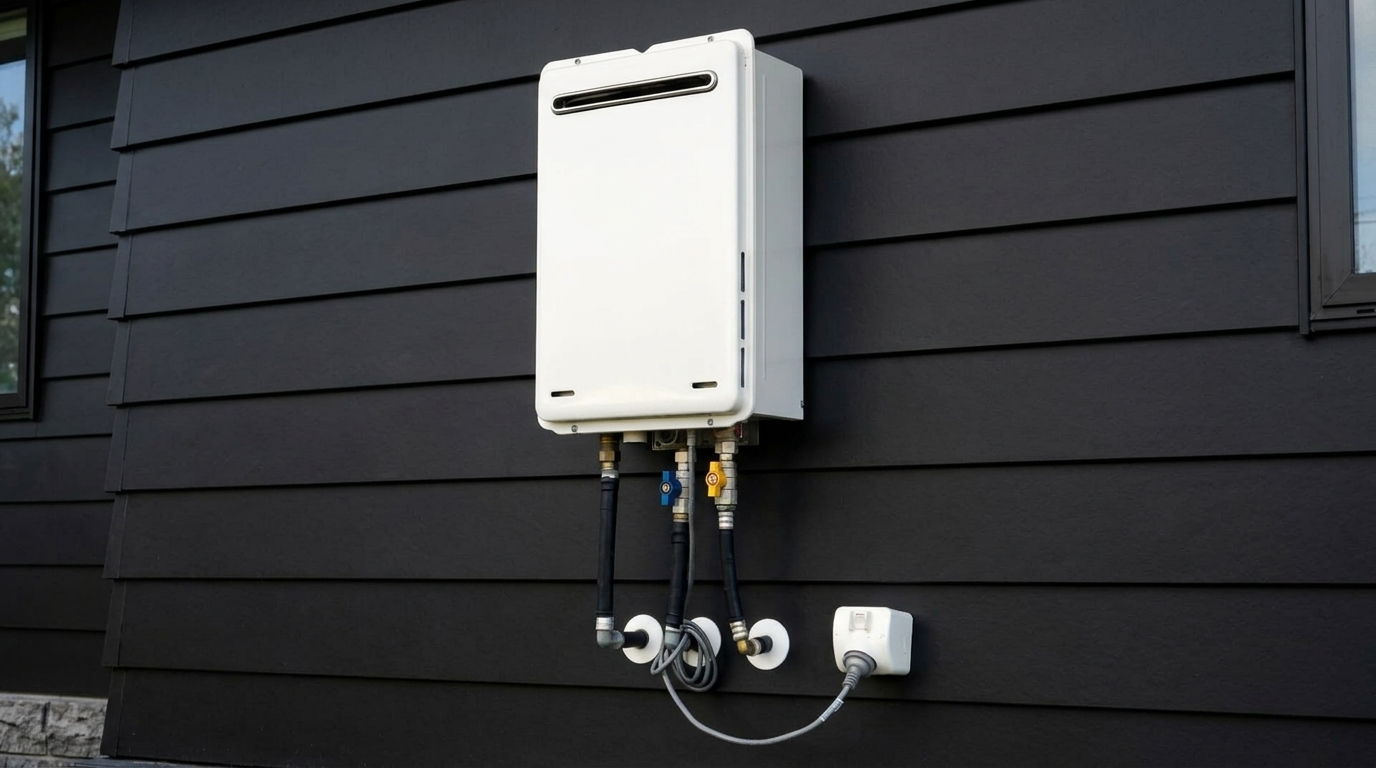
A tankless water heater, also called an on-demand or instantaneous water heater, heats water only when you need it, rather than keeping a large volume of water hot around the clock. This eliminates the storage tank entirely, replacing it with a compact, wall-mounted unit.
Because there’s no tank to drain or run out of hot water, tankless systems are designed to provide a continuous supply, so long as the unit is sized correctly for your household’s demand.
How Does a Tankless Water Heater Actually Heat Water?
When you turn on a hot water tap, a flow sensor inside the tankless unit detects water movement and activates the heating mechanism, which then rapidly heats the water as it passes through a heat exchanger. The entire process happens within seconds, giving the impression of instant hot water even though nothing was being heated beforehand.
The Heat Exchanger
At the core of every tankless system is a heat exchanger made up of coiled pipes or parallel plates. As water passes through this exchanger, either a gas burner or an electric element rapidly raises its temperature before it exits the unit and travels to your faucet or shower.
The Flow Sensor
A flow sensor continuously monitors water movement through the unit. The moment it detects flow, typically when a faucet is turned on, it signals the system to begin heating. When the faucet shuts off, the sensor detects the drop in flow, and the unit stops heating almost immediately, avoiding the standby energy loss that tank-style systems experience constantly.
The Heating Source: Gas or Electric
Tankless water heaters come in both gas and electric models, and the heating source determines how quickly the unit can raise water temperature. Gas tankless units generally provide higher flow rates and are often better suited for larger households, while electric models tend to be more compact and easier to install in homes without existing gas lines.
Why Tankless Systems Don't Run Out of Hot Water
Because a tankless water heater heats water continuously as it flows through the unit rather than drawing from a fixed, stored supply, it doesn’t run out of hot water the way a tank system can during heavy use. As long as the unit’s flow rate capacity isn’t exceeded by simultaneous demand, like a shower and a washing machine running at once, hot water keeps coming for as long as you need it.
This is also where correct sizing becomes essential. According to the U.S. Department of Energy, sizing a tankless water heater involves calculating your household’s desired flow rate, meaning the combined gallons per minute needed to run multiple fixtures simultaneously during peak usage. An undersized unit can still run out of adequate hot water pressure if too many fixtures draw from it at once.
Tankless vs. Traditional Tank Water Heaters
The core difference between the two systems comes down to standby energy loss. A tank water heater continuously reheats stored water to maintain its set temperature, while a tankless unit only uses energy when water is actively flowing through it.
Feature | Tankless Water Heater | Traditional Tank Water Heater |
Hot water supply | Continuous, as long as flow rate isn’t exceeded | Limited by tank size |
Standby energy loss | None | Ongoing, even when not in use |
Typical lifespan | 20+ years | 8–15 years |
Space required | Compact, wall-mounted | Larger floor space needed |
Upfront cost | Higher | Lower |
Because tankless units only heat water as needed, ENERGY STAR estimates that a certified gas tankless water heater can save a family of four roughly $95 per year in gas costs compared to a standard storage tank model, which adds up significantly over the unit’s lifespan.
Common Tankless Water Heater Myths
A few persistent myths keep some homeowners from considering tankless systems, even though most no longer reflect how modern units actually perform.
- “Tankless water heaters can’t keep up with multiple showers at once.” Modern whole-home tankless units, when sized correctly for a household’s peak demand, can absolutely support multiple simultaneous uses.
- “Tankless systems don’t work with gas lines in older homes.” In many cases, existing gas lines can be used, though some older homes may need a gas line upgrade to support a tankless unit’s higher flow requirements. Fuel type affects not just operating costs but also a tankless unit’s size and efficiency, which is why a professional assessment of your home’s existing gas or electrical setup matters before installation.
- “There’s no difference in water temperature consistency.” Tankless units provide a steady temperature throughout use, since they’re not drawing down a finite, cooling supply the way a tank system does toward the end of a long shower.
- “Tankless units require no maintenance.” Tankless systems still need regular descaling, especially in areas with hard water like much of Alabama, to prevent mineral buildup inside the heat exchanger.
What Birmingham Homeowners Should Know About Hard Water and Tankless Systems
Alabama’s hard water can accelerate mineral buildup inside a tankless unit’s heat exchanger, which is why regular descaling matters more here than in regions with naturally softer water. Left unaddressed, scale buildup can reduce efficiency and eventually damage internal components.
Routine maintenance, including periodic descaling and flow sensor checks, keeps a tankless system performing at its rated efficiency and helps it reach the upper end of its expected 20-year lifespan. Many homeowners pair a tankless system with a water softener to further reduce mineral buildup, extending the time between professional descaling visits.
How Standard Helps You Choose and Maintain a Tankless System
Standard Heating, Cooling & Plumbing performs a full flow rate calculation based on your household’s peak usage, accounting for scenarios like running a shower and dishwasher at the same time, to size your tankless unit correctly. Our technicians are factory-trained to install, service, and repair both gas and electric tankless systems.
What sets us apart:
- Over 85 years of local experience serving Birmingham, Hoover, Vestavia Hills, and the surrounding Jefferson and Shelby County communities
- Factory-trained technicians specializing in tankless flow rate calculations, thermal expansion tank installation, and dip tube replacements
- NATE-certified plumbers experienced with both traditional tank and modern tankless systems
- The Blue Chip Club maintenance plan, helping extend your tankless system’s lifespan through regular descaling and inspection
- Flexible financing through GoodLeap to make a tankless upgrade more accessible
Ready to upgrade to endless hot water? Contact Standard Heating, Cooling & Plumbing to schedule your tankless water heater consultation.
Frequently Asked Questions
How long do tankless water heaters typically last?
Tankless water heaters generally last 20 years or more with regular maintenance, significantly longer than the 8 to 15-year lifespan of most traditional tank water heaters.
Can a tankless water heater supply an entire multi-bathroom home?
Yes, with a proper flow rate calculation based on peak household usage, a correctly sized whole-home tankless unit can meet the demand of multiple bathrooms running simultaneously.
Do tankless water heaters require electricity even if they run on gas?
Most gas tankless models require a small amount of electricity to power the ignition system and electronics, so a power outage can affect operation even on a gas unit.
How often should a tankless water heater be descaled?
In areas with hard water, like much of Alabama, annual descaling is generally recommended to prevent mineral buildup from affecting efficiency and the unit’s lifespan.
Is switching from a tank to a tankless system a complicated installation?
It can require additional work, such as upgrading gas lines or electrical capacity, depending on your home’s existing setup, which is why a professional assessment is an important first step.
Does a tankless water heater provide hot water instantly at the faucet?
The unit itself heats water almost instantly, but there’s still a short delay while the already-cooled water sitting in your home’s pipes clears out, similar to the wait time with a traditional tank system.